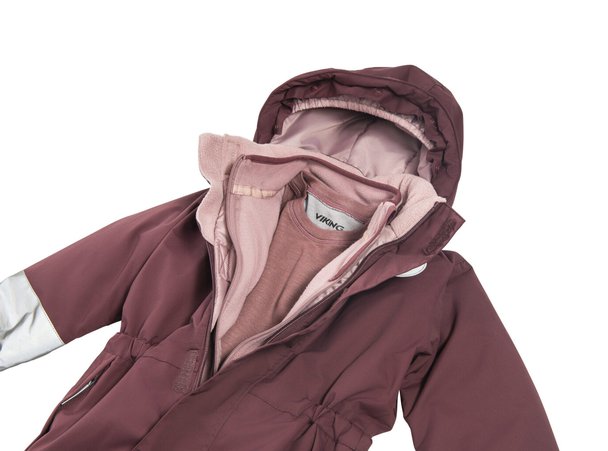
How to choose a winter snowsuit for your child: what really matters?
One day it’s −10°C with dry snow; the next it’s +2°C, windy and full of puddles. That’s why a “warm” label alone isn’t enough when choosing a winter snowsuit for your child. Think about how much your child moves, whether the clothing keeps moisture out, and whether there’s room for an extra layer underneath.
In short: active children usually need good moisture protection, freedom of movement and the option to adjust warmth through layering. A child who spends most of the walk in a stroller may need more insulation. Consider insulation weight, fabric properties and fit together rather than separately.
First, think about what your child does outdoors
Two children of the same age may need different clothing on the very same day. One runs, climbs and rolls in the snow at preschool. Another spends more time standing still or riding in a stroller. The first generates more heat through movement, while the second gets cold more quickly.
So rather than starting with a temperature rating, we recommend asking three questions: How active is your child? How long will they be outside? And are you more likely to encounter dry frost or wet snow?
What do 160 g and 200 g of insulation actually mean?
Winter clothing labels often list insulation weight in grams per square metre (g/m²). This figure is useful for comparing garments, but it does not, by itself, tell you at what temperature your child will feel warm. Fabric, wind, layers and activity level matter too.
Even two snowsuits with the same insulation weight can retain heat differently. The type of insulation, outer fabric and garment construction all play a part. Treat a manufacturer’s temperature range as guidance for that particular model, not as a universal rule for every snowsuit with the same insulation weight.
Practical tip: if your child gets too warm while moving, the thickest snowsuit is not necessarily the best choice. It is often easier to adapt the mid-layer to the weather than to buy a different snowsuit for every temperature.
In Latvia’s winters, moisture protection matters as much as warmth
Wet snow and puddles can be more troublesome than dry frost. If outerwear gets soaked, a child can quickly become uncomfortable, even in a thick snowsuit.
When comparing styles, look at three things:
- Water resistance. Often measured in millimetres (mm). A higher rating indicates greater resistance to water pressure in a laboratory test, but the construction of the garment also matters.
- Taped seams. Water can seep in through seams, so check whether all seams are sealed or only the most exposed ones.
- Breathability. This describes how well water vapour can escape through the fabric. It matters especially for active children, as moisture should not build up inside the garment.
For more on how membranes work, read our guide What is GORE-TEX?.
How can you tell if a snowsuit fits properly?
Parents often ask whether they should buy a winter snowsuit with growing room. Some extra space for growth and layers is useful, but an oversized snowsuit can be awkward: sleeves slide down, trouser legs bunch up above boots, and movement becomes harder.
Try the snowsuit on with the clothing your child will actually wear in winter, and check:
- can your child squat and raise their arms without the fabric pulling tightly?
- do the sleeves and trouser legs stay in place as they move?
- is there enough room underneath for the layers they need?
- are the hood, collar and zip comfortable?
Important: sizing and built-in growing room vary between brands. Do not automatically size up: compare your child’s height with the size chart for the specific brand and model first.
What should your child wear under a winter snowsuit?
Even an excellent snowsuit cannot feel equally comfortable in every kind of weather if the clothing underneath always stays the same. Layering lets you adapt to both freezing conditions and energetic play.
| Layer | Purpose | What to choose |
|---|---|---|
| First — next to skin | Helps maintain comfort and move moisture away | Merino wool or technical base layers |
| Second — mid-layer | Adds warmth when needed | Fleece or wool tops and trousers, depending on the cold and activity level |
| Third — outer layer | Protects against wind, snow and moisture | A snowsuit suited to the weather and your child’s activity |
A thick mid-layer isn’t always necessary during active outdoor play. But if a child spends most of the time sitting in a stroller, the same combination may not be warm enough. Read more about the layering principle and the properties of merino wool.
What else should you check before buying?
Sometimes the little practical details determine whether your child enjoys wearing a snowsuit. Check that the zip is easy to fasten, gloves fit comfortably with the cuffs, and trouser legs cover the tops of boots. Reflective details are useful too, as winter journeys home often happen at dusk.
If the hood is detachable, check how it attaches. On some models, the design also supports safer play; always check the product description for the specific fastening system.
Frequently asked questions about winter snowsuits
Is 160 g of insulation enough for winter?
It can be, especially for an active child, but it depends on the specific model, wind, moisture, layers and how long your child stays outdoors. Use the manufacturer’s suggested temperature range as a guide and pay attention to your child’s comfort.
Which is more practical: a snowsuit or a jacket and trousers?
A one-piece snowsuit is convenient for playing in the snow because there is no gap between jacket and trousers. A two-piece set may be more practical if your child frequently goes indoors or wears the jacket and trousers separately.
Should you buy a winter snowsuit one size larger?
Not necessarily. Fit and built-in growing room vary by brand. Oversized clothing can restrict movement, so it’s more useful to measure your child accurately and check the size chart for the particular style.
How can you tell whether your child is too hot or too cold?
Notice how your child feels and check the neck or upper back. Very hot or sweaty skin may mean they are wearing too many layers; if they feel cold, shiver or complain of being cold, they need more warmth. Cold hands alone are not a reliable guide.
Choose for your child, not just the number on the label
The best winter snowsuit is not necessarily the thickest one. It should let your child move freely, stay dry and feel comfortable on everyday outings. When comparing models, consider not just the insulation weight but also the membrane, fit and the layers you plan to put underneath.
Explore children’s outerwear at LIBERI. If you have questions about the size or features of a particular style, contact us — we’ll help you compare options. You can also try items on at our store in Riga.